
Corporate Governance
Corporate Governance
Corporate Governance and Compliance Framework
IRM which manages ADR’s assets, has established a corporate governance framework by setting up investment and compliance committees to oversee the execution of corporate governance and defined its commitments to its fiduciary duty.
With the framework in place, IRM endeavors to manage risks, to comply to laws and regulations and ensure fair handling of transactions with conflict of interest,
Please refer here for details on the compliance framework.
Please refer here on measures to insure fair handling of transactions with conflict of interests.
Management Fee Structure
The asset management fee shown on the table below paid from ADR to IRM took effect from February 1, 2026.
In addition to the existing NOI and FFO per unit-linked fees tied to the underlying earnings power of the portfolio assets,we will introduce a new fee structure linked to Profit Before Tax and distributions per unit. This aims to further enhance alignment with unitholder returns.
A fee structure to further enhance alignment with unitholders’ interests
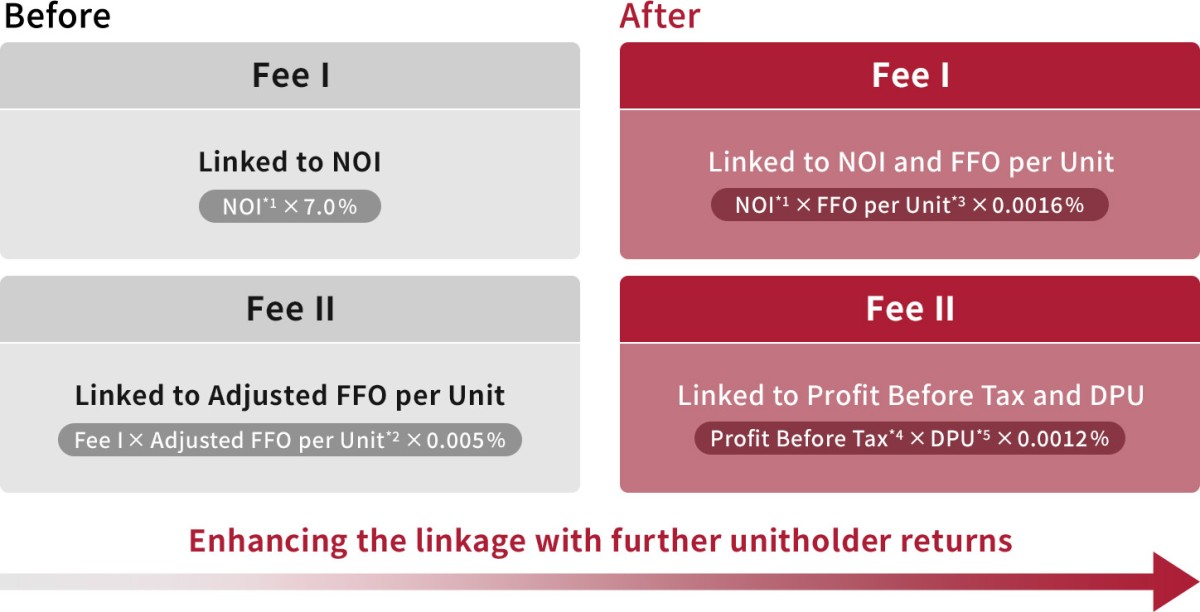
*1 NOI = the total of the Investment Corporation’s real estate rental business income (if invested assets includeequity interests in silent partnerships or real-estate-backed securities involving real estate, including the dividends relating to these invested assets or other forms of income) after subtracting the total of the real estate rental business expenses (excluding depreciation expenses and losses on the sale or retirement of non-current assets) for the relevant accounting term
*2 Adjusted FFO per Unit = the figure obtained by taking net income for the relevant accounting period before deduction of Fee II (prior to the change), adding depreciation, impairment losses, and amounts corresponding to losses on the sale of real estate and real-estate-backed securities, and subtracting gains on bargain purchase (negative goodwill) and amounts corresponding to gains on the sale of real estate and real-estate-backed securities, and then dividing that amount by the number of investment units issued as of the relevant fiscal period-end.
*3 FFO per Unit = The figure obtained by taking the net income for the relevant fiscal period before deducting Fee I (after the change) and Fee II (after the change), theamounts of non-deductible consumption tax and corporate income taxes, etc. related to the said asset management fees; adding depreciation expenses, impairment losses, amortization of goodwill, and amounts equivalent to losses on sales of real estate andreal estate-related securities; subtracting amounts equivalent to negative goodwill gains and capital gains on sales of real estate and real estate-related securities; and dividing the result by the number of investment units outstanding as of the relevant fiscal closing date.
*4 Profit Before Tax = The figure obtained by taking the net income for the relevant fiscal period before deducting Fee I (after the change) and FeeII(after the change) , the amounts of non-deductible consumption tax and corporate income taxes, etc. related to the said asset management fees; adding impairment losses, amortization of goodwill, and amounts equivalent to losses on sales of real estate and real estate-related securities; subtracting amounts equivalent to negative goodwill gains and profits from sales of real estate and real estate-related securities.
*5 DPU = The figure obtained by taking the net income for the relevant fiscal period before deducting Fee I (after the change) and Fee II (after the change), the amountsof non-deductible consumption tax and corporate income taxes, etc. related to the said asset management fees; adding retained earnings brought forward from the previous period and reversal of voluntary reserves; subtracting the amount retained earnings carried forward to the next period and appropriation to voluntary reserves; and dividing the result by the number of investment units outstanding as of the relevant fiscal closing date.
Preventing Misconduct and Corruption
IRM recognizes that legal compliance is a matter of course, and that IRM must continue to be an organization that is trusted by society. IRM have established various rules and prevention system.
Disclosure of rewards
The executive compensation of ADR officers is determined as follows based on the Investment Corporation Agreement. In addition, please refer to the fiscal report for the specific amount of compensation.
(1)The maximum monthly remuneration for executive officers is 1 million yen, which is determined by the board of directors as an amount that is judged to be reasonable in general price trends and wage trends.
(2)The maximum monthly remuneration for supervisors is 500,000 yen per person, and the board of directors decides the amount as it is judged to be reasonable in general price trends and wage trends.
Performance on Compliance and Prevention of Misconduct and Corruption
IRM holds a wide range of compliance training tailored to the target.
Please see the link below for details on the training outline and the results of compliance cases.
Disclosure
In order to ensure disclosure transparency, in addition to statutory disclosures, ADR will disclose information it deems useful and valuable on timely bases in an easy-to-understand form. Specifically, ADR will actively disclose information on its website in addition to disclosing on the Tokyo Stock Exchanges disclosure system (TDnet).
Please click here to read the disclosures.
Please refer here for information on investor meetings and conferences.
Results of Investor Relations Activities
|
Target |
IR activities |
FY2024 |
|---|---|---|
| Individual investors |
Earnings briefings and seminars |
6 times |
| Institutional investors |
Earnings briefings |
2 times |
|
IR meetings (Japan) |
93 companies |
|
|
IR meetings (overseas) |
53 companies |
Legal and Regulatory Restrictions
- The executive director and the supervisory directors of ADR are not allowed to transact ADR units for itself or for a third-party in accordance to ADR’s bylaw.
- If the executive director and the supervisory directors of ADR commit illegal or improper acts or make improper profits, they may be punishable not only by law but by accordance to ADR’s bylaw.
- Rights of unit-holders are defined in the “Act on Investment Trust and Investment Corporations” and “Articles of Incorporation of Investment Corporation”. For detail please refer to ADR’s financial report (in Japanese only) submitted to the Financial Services Agency.
- The compensation to the directors of ADR is restricted by the Articles of Incorporation of ADR, in which payment rules(An amount determined by the board of directors as an amount deemed reasonable in light of general price trends, wage trends, etc., within the maximum monthly amount set in the Articles of Incorporation.)are laid down.
- Due to the legal system, J-REITs cannot issue class shares (investment units that differ from ordinary investment units in terms of rights such as dividends and distribution of residual assets, or voting rights, etc.; so-called "class units") similar to class shares under the Companies Act. ADRs do not issue such class units because J-REITs are not allowed to issue such units.
- The first managing partner of ADR's auditor cannot be in charge of auditing for more than 5th FP (2.5 years) and the managing partner for more than 7th FP (3.5 years) under the Certified Public Accountants Act.